Elf
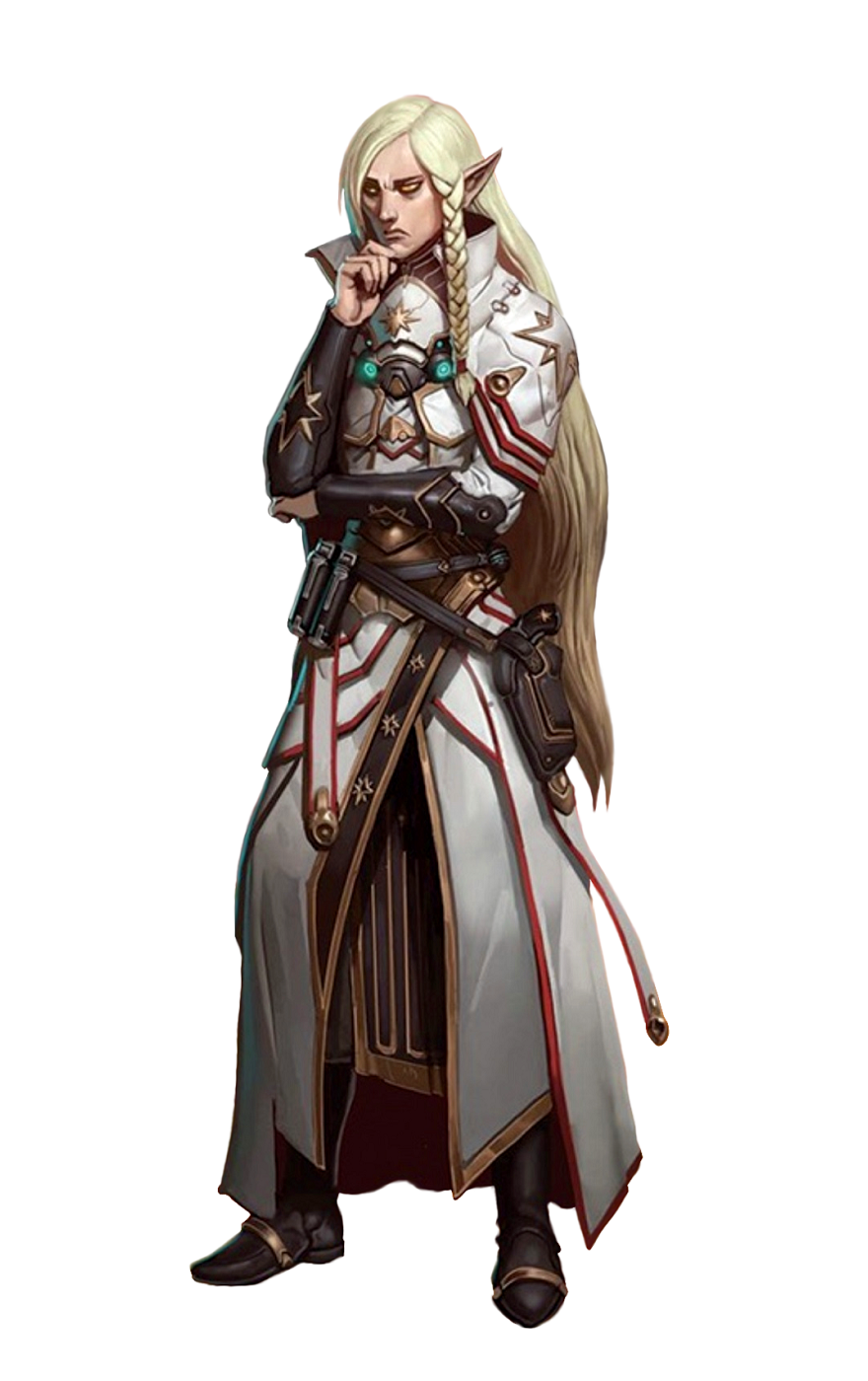
| Classification | Humanoid |
| Primary Homeland | Alfheimr — present throughout |
| Typical Alignment | Any |
| Size | Medium |
| Height | Average to tall |
| Build | Slender |
| Complexion | Full human range; also copper, bronze, near-white |
| Eyes | Gold or silver — luminous; also green or blue |
| Hair | Wide range; green and blue possible |
| Lifespan | Centuries |
| Languages | Common, Elvish |
| Source | 2024 PHB |
Overview
Elves are a magical people of otherworldly grace, living in the world but not entirely part of it. They inhabit places of ethereal beauty — ancient forests, silver spires glittering with faerie light, places where soft music drifts through the air without apparent source and the geometry of things feels slightly more deliberate than elsewhere. Elves love nature and magic, art and artistry, music and poetry, and the long pleasures that shorter-lived peoples cannot fully access: the unfolding of a century's worth of changing seasons, the gradual evolution of a relationship over decades, the way a city rewrites itself generation by generation. They have been watching the world for a long time. They have opinions about what it is doing.
They are slightly taller than humans on average — well over five feet to just over six — and more slender, with a proportion that suggests both fragility and precision, the way a well-made blade does. Coloration runs the normal human range but extends beyond it: skin in shades of copper, bronze, and almost bluish-white; hair of green or blue where the fey blood runs strong; eyes like pools of liquid gold or silver. They have no facial hair and very little body hair. Their faces are capable of a wide range of expression but default to a composed quality that humans sometimes read as coldness. It is not coldness. It is the particular stillness of a person who has learned to wait.
The primary elven homeland in the Yggdrasil setting is Alfheimr, the nation built around the World Tree's canopy and considered by most elves to be the spiritual and ancestral center of elven civilization. Elven society within Alfheimr is stratified, ancient, and complicated — more internally diverse than outside observers typically appreciate, with genuine and sometimes bitter disagreements between its major lineages. Drow exist largely outside Alfheimr's political structure, with a history of separation whose details remain contested. Wood Elves have established forested communities throughout the continent, close enough to the center to maintain connection and distant enough to do as they like.
An elf who has lived two centuries has witnessed events that human historians reconstruct from documents. This is not a hypothetical advantage — it shapes everything about how elves engage with politics, relationships, and the interpretation of current events. They have context. They remember the last time this particular sequence of decisions was made. They know how it ended. Whether they choose to share that knowledge, and in what form, is among the most consequential choices an elf makes in any given century.
Culture
Elf culture varies significantly by lineage. Drow, High Elf, and Wood Elf carry distinct traditions that share a common ancestry but have diverged over centuries. What follows reflects broad commonalities across all elven peoples.
Long Memory, Long Grudges
Across lineages, the single most significant fact about elven culture is the relationship between lifespan and memory. Elves do not merely know the past — they remember it, which is a different thing entirely. Events that human historians reconstruct from crumbling documents, an elf of sufficient age witnessed. They can tell you what the negotiator's voice sounded like when they made the promise that was later broken. They can describe the weather the day the treaty was signed. This is not nostalgia — it is precision, and it informs every subsequent judgment.
The consequence is that elven communities hold things with extraordinary tenacity. Old alliances remain warm past any practical reason because they are remembered as warm from when they were made, and the memory is real and recent. Old insults remain sharp for the same reason. An elf who was personally slighted by a family three generations of that family ago has not "moved on" in the way a human would — they have simply been patient. Whether this constitutes a virtue or a pathology depends heavily on the specific grudge.
Communities that deal regularly with elves learn to be careful, across long time horizons, about what they do and say. The human diplomat who makes an offhand dismissive comment today may not encounter its consequences for decades — but the elf they said it to has not forgotten, and their grandchild will feel the coolness.
The Trance
Elves do not sleep. Instead they enter a meditative trance — four hours of half-waking stillness that serves the same restorative function as a full night's sleep for other species. During the trance, an elf remains dimly aware of their surroundings while reliving vivid memories from their long life. This is not passive; many elves use the trance time deliberately, selecting which periods of memory to revisit and what they want to examine in them.
The practical implications are considerable. Elves can maintain watch through a night that their companions must sleep through. They can process and integrate experience during what other peoples call downtime. A long trance — several consecutive nights of deliberate memory-work — is used by many elves as a grieving practice, a way of fully inhabiting and releasing significant losses.
The memories that surface during trance tend toward the emotionally significant rather than the chronologically recent. An elf in trance might be reliving events from a century ago with the same vividness as something that happened last week. This gives experienced elves a relationship with their own past that is less like a historical record and more like a landscape they continue to walk through — familiar, revisited, never fully finished.
Lineage & Its Weight
The three major elven lineages — Drow, High Elf, and Wood Elf — carry histories that are simultaneously connected and sharply distinct. Each lineage traces itself to a different branch of the ancient elven family tree, and the divergences have accumulated over centuries into cultural differences that go well beyond the aesthetic.
High Elves carry the tradition most closely associated with Alfheimr's formal institutions: arcane scholarship, political administration, and the kind of refined artistry that requires generations of accumulated technique. They tend toward intellectual confidence and can shade into condescension when dealing with peoples they consider less developed — a habit most are aware of and few have fully corrected.
Wood Elves diverged toward the natural world and away from formal hierarchy. Their communities are smaller and more egalitarian, their relationship with magic more intuitive than studied. They have a reputation among other elves for being difficult to find and easy to underestimate — both of which they consider features rather than bugs.
Drow carry the most contested history. The separation between Drow and surface elves involves a set of events that different communities narrate very differently, and the current relationship between them ranges from tense diplomatic distance to outright hostility depending on who you ask and where you ask it. Most Drow regard the surface elves' narrative of their separation as self-serving. Most surface elves regard the Drow narrative as incomplete. Both are probably right.
Alfheimr & the World Tree
Alfheimr's position adjacent to the World Tree gives elven civilization a relationship with the divine that is simultaneously privileged and complicated. The Tree is not an elven god — it belongs to no one people — but elves have lived in its presence longer than most other nations have been aware of its existence, and this proximity has shaped their spiritual and aesthetic traditions in ways that are difficult to disentangle.
Elven religious practice in Alfheimr tends toward reverence for the Tree as a cosmological fact rather than a deity to be petitioned. You do not ask the Tree for things. You exist in its presence and, if you are attentive, you learn from what that presence teaches. This has produced a spiritual tradition of great sophistication and almost no missionary impulse — elves do not generally feel the need to convince other peoples of their relationship to the Tree, because the Tree is there for everyone to experience.
Elves who have spent significant time in Alfheimr near the Tree's roots often describe a quality of perception that is difficult to articulate to those who haven't shared it: a sense of time working differently, of individual events occupying less significance than they do elsewhere, of the long continuity of living things being unusually present to consciousness. Some find this deeply comforting. Others find it disorienting. A few find it paralyzing, and these are the elves who tend to relocate to somewhere the Tree's influence is less immediate.
Art as Legacy
Elven art operates in time scales that other peoples cannot easily plan for. An elf who begins a painting at forty may still be working on it at two hundred — not because they are slow, but because they are refining something that requires centuries of accumulated skill and perspective to get right. Elven musical compositions unfold over hours; elven novels contain lifetimes of detail; elven architecture is designed to be experienced across multiple visits separated by decades. The work is made for an audience with the patience of centuries, and it repays that patience.
This creates a creative tradition of extraordinary depth and an accessibility problem that elves acknowledge with varying degrees of concern. Other peoples often find elven art beautiful in ways they cannot fully articulate and engaging in ways they cannot fully access — they sense the depth without having the lifespan to plumb it. Some elven artists adapt their work for shorter-lived audiences, producing condensed versions that sacrifice nuance for reach. Others consider this a category error, producing art for humans the way you would translate a poem: something is inevitably lost, and the translation is not the work.
The debate between these positions has been ongoing in Alfheimr's artistic community for approximately four centuries, which is considered rapid by elven standards.
Statblock
layout: Basic 5e Layout
name: Elf
source: Yggdrasil World System
size: Medium
type: humanoid
subtype: ""
alignment: any alignment
ac: 10
hp: —
speed: 30 ft.
stats: [10, 10, 10, 10, 10, 10]
senses: darkvision 60 ft.
languages: Common, Elvish
cr: "—"
traits:
  - name: "Elven Lineage"
    desc: "You are part of an elven lineage that grants you supernatural abilities. Choose a lineage from the options below. You gain the Level 1 benefit of that lineage immediately, and the listed spells at Level 3 and Level 5. You can cast each of those spells once without a spell slot, regaining the ability to do so when you finish a Long Rest. You can also cast them using any spell slots you have. Your spellcasting ability for these spells is the one indicated by your lineage. Drow — Level 1: Dancing Lights cantrip. Level 3: Faerie Fire. Level 5: Darkness. Spellcasting Ability: Charisma, Wisdom, or Intelligence (chosen when you select this lineage). High Elf — Level 1: Prestidigitation cantrip. Level 3: Detect Magic. Level 5: Misty Step. Spellcasting Ability: Intelligence. Wood Elf — Level 1: Druidcraft cantrip; your Speed increases by 5 feet. Level 3: Longstrider. Level 5: Pass Without Trace. Spellcasting Ability: Wisdom."
  - name: "Fey Ancestry"
    desc: "You have Advantage on saving throws you make to avoid or end the Charmed condition on yourself."
  - name: "Keen Senses"
    desc: "You have proficiency in the Insight, Perception, or Survival skill."
  - name: "Trance"
    desc: "You don't need to sleep, and magic can't put you to sleep. You can finish a Long Rest in 4 hours if you spend those hours in a trancelike meditation, during which you retain consciousness."
Designer Note
Elves are the setting's deep-time perspective — a people who remember things that everyone else has forgotten and are shaped by a relationship with history that shorter-lived species cannot fully share. The Drow/High Elf/Wood Elf split is treated as a genuine cultural fracture rather than a cosmetic palette swap; encourage players to think about which lineage shapes their character's worldview. The trance section is offered as direct roleplaying support — what does your elf return to during those four hours?
See Also
- Alfheimr — primary elven homeland
- _Species Index
- Yggdrasil World System