Tieflings
| Classification | Humanoid |
| Primary Homeland | Widespread |
| Typical Alignment | Any |
| Size | Medium |
| Height | Average |
| Build | Varies |
| Complexion | Blue, black, red, purple — unusual tones |
| Eyes | Solid color — ember-bright |
| Horns & Tail | Present; form varies by infernal lineage |
| Languages | Common + one of choice |
| Source | 2024 PHB |
Overview
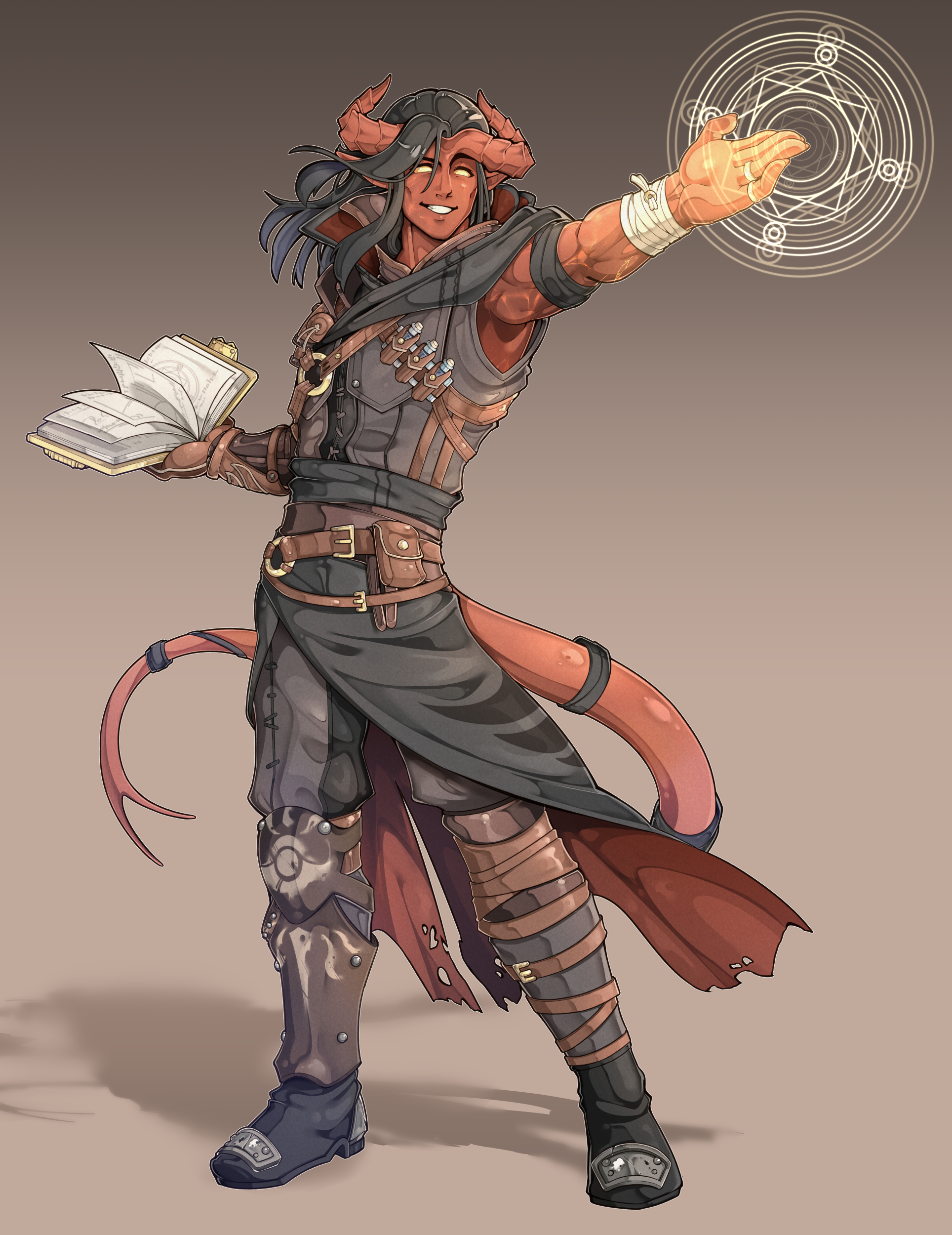
Tieflings bear the mark of infernal heritage in ways that cannot be concealed and are rarely mistaken. Their skin tones fall outside the range of any other humanoid species — blues, blacks, deep reds, amethyst purples — and their eyes burn with a solid, ember-like quality that makes sustained eye contact an experience most find unsettling. Horns crown their heads in forms that vary by lineage: curved, swept back, branched, spiraled. Their tails move with a life of their own, betraying mood in ways that Tieflings learn early to suppress in public and rarely bother to in private. The physical effect is distinctive, and in most societies it carries weight before the person behind it has said a word.
Their infernal ancestry tracks to ancient pacts — bargains made generations ago between mortal families and extraplanar powers whose full nature was usually not understood by the mortals making the deal. Tieflings are not those bargain-makers. They are the interest compounding on a debt they did not incur, wearing the evidence of it on their skin and horns. Most find this unfair. Most are also right. The pact that shaped their bloodline was someone else's choice, and the consequences have been running downstream ever since.
Three major lineages exist: Abyssal (demonic, associated with poison and chaos), Chthonic (necrotic, associated with death and entropy), and Infernal (fiendish proper, associated with fire and contract). The distinctions matter in temperament and capability as much as in appearance — Abyssal Tieflings tend toward volatility, Chthonic toward a particular quality of patience that others read as coldness, and Infernal toward precision and a relationship with obligation that is complicated by the fact that their bloodline originated in a violated one. These are tendencies, not destinies, and Tieflings are aware that other peoples know about the tendencies, which is its own complication.
Within the Yggdrasil setting, Tieflings are found in most major cities and in disproportionate numbers in a few specific contexts: arcane institutions, underground economies, and organizations that require people who have spent their lives developing resilience to suspicion. They hold no single homeland and have built no single political identity, but they have built networks — informal, overlapping, and more extensive than most outside observers realize.
Culture
Tieflings have no unified homeland or cultural center. Their communities exist wherever tolerance or indifference permits, and many Tieflings live their entire lives without ever meeting more than a handful of others like them. What follows describes common patterns shaped by the experience of being visibly marked.
The Weight of Appearance
Most Tieflings spend at least part of their life being treated as what they look like rather than who they are. The specific form this takes varies by region — outright hostility in some places, suspicion in others, the more manageable form of fascination in cosmopolitan cities that have seen enough of the world to be curious rather than frightened. Learning to navigate this without either retreating entirely or leading with bitterness is a developmental task that shapes most Tiefling personalities in some direction.
The work of being seen accurately — not as a symbol of infernal power, not as a danger to be managed, not as an exotic curiosity, but as an individual person with a specific interior life — is work that most Tieflings do continuously and without recognition for doing it. It is not performed for applause. It is performed because the alternative is allowing the projection to become the reality, which is the genuinely bad outcome and the one Tieflings are most vigilant against.
The communities that produce the most psychologically healthy Tieflings are, consistently, the ones that found ways to engage with the infernal ancestry as a fact about the person rather than a statement about them. You are descended from someone who made a choice that had consequences. Here you are, downstream of that choice. What are you going to do with what you are? This framing — curious, matter-of-fact, without the layers of moral weight other communities add — is rare and, when found, deeply valued.
The Three Legacies
Abyssal, Chthonic, and Infernal Tieflings are distinct in ways that go beyond elemental damage types. The lineages carry different cultural associations, different relationships to their own infernal heritage, and different patterns of interaction with the broader world.
Abyssal Tieflings carry the most chaotic of the three legacies — their progenitor powers were demonic rather than contractual, which means the original bargain was almost certainly messier and less precisely defined than an Infernal one. Abyssal communities, where they exist, tend toward the improvised and the adaptable. They are less likely to plan ten moves ahead and more likely to respond to what is actually happening with an improvisational competence that can look, from the outside, like recklessness. It is not recklessness. It is the cultivated flexibility of people who learned early that planning past the next obstacle is usually optimistic.
Chthonic Tieflings exist in relationship with death and entropy in ways that most cultures find uncomfortable but that the Tieflings themselves tend to treat with equanimity. Their heritage runs to powers associated with the boundary between living and dead, and the cultural tradition that has developed around this is less morbid than outside observers expect — it tends toward a practical acknowledgment of endings, an ease with impermanence, and a somewhat unsettling comfort in situations where other peoples are distressed by the presence of death. Chthonic communities tend to be the most stable of the three, possibly because people who are at peace with endings have fewer illusions to lose.
Infernal Tieflings carry the most legible and most complicated heritage. Their bloodline traces to fiends who operate through contract and obligation — precise, binding, consequential agreements that shaped the fate of the mortal family who made them. Growing up Infernal means growing up with an instinctive awareness of the weight of promises, the structure of agreements, and the way that obligations propagate downstream through generations. Many Infernal Tieflings become extraordinary lawyers, negotiators, and strategists. Most also have complicated feelings about this.
Chosen Community
Tieflings who find their people — a community that extends trust before requiring proof of merit — tend to hold onto them with a fierceness that surprises people who encountered them first in their defensive public persona. Found family formations are common: tight networks of people who have each agreed, implicitly or explicitly, to take each other on faith and protect each other from the world's assumptions.
Within these formations, Tieflings are often among the most loyal members of any group they commit to. The loyalty reflects the difficulty of forming the commitment in the first place — when trust has been hard to earn and harder to maintain, the relationships where it exists become correspondingly precious. A Tiefling who has decided that you are someone worth protecting is worth having in any corner of any room.
The threshold for admission to a Tiefling's inner circle is high and the evidence required is specific. Not performance of good intentions — anyone can perform that — but demonstrated behavior across enough situations that the pattern is undeniable. Tieflings have extensive experience distinguishing between people who mean well in easy circumstances and people who mean well when it costs them something. They value the latter disproportionately and identify them reliably.
The Arcane Pull
A significant proportion of Tieflings develop an affinity for magic, both because their infernal lineage predisposes them to it and because magic is one of the few domains where raw capability speaks for itself regardless of heritage. Tiefling arcane practitioners are found across the continent in proportions that significantly exceed their general population, and most have well-developed opinions about being told they only got there because of their bloodline.
The nature of the magical affinity varies by legacy. Abyssal Tieflings tend toward disruptive and transformative magic — spells that change states, poison, hold, or disrupt rather than purely destroy. Chthonic Tieflings are drawn to the liminal: magic that operates at boundaries, that touches the dead, that manipulates the flow of life force. Infernal Tieflings lean toward fire and precision — bright, targeted, consequential effects that leave little ambiguity about what happened.
These affinities are tendencies rather than constraints, and many Tiefling mages develop against type. But the tendencies are real enough that experienced arcane scholars can often identify a Tiefling's lineage from their casting choices before they ask directly.
Reclamation & Identity
The most significant cultural development among Tiefling communities in the last several generations has been a deliberate project of identity reclamation: defining what it means to be a Tiefling on their own terms rather than on the terms imposed by the cultures that surround them. This is not a unified movement with a central organization — it is a distributed shift in how Tieflings talk to each other, raise their children, and present themselves to the outside world.
The core of it is a refusal to accept the terms of the original judgment. Yes, the bloodline carries infernal influence. Yes, this is visible and cannot be hidden. No, this does not make a Tiefling a danger to be managed, a debt to be paid, or a punishment to be endured. What it makes them is a person with a specific and unusual inheritance, and what they do with that inheritance is their own business, exactly as it is for anyone else.
Tieflings who have internalized this framing carry themselves differently — not with aggression or defiance, but with a calm self-possession that older generations sometimes find surprising. They are not trying to prove they are safe. They have stopped treating "safe" as the relevant question. The relevant question is whether they are who they want to be, and that is a question they are working on, same as everyone else.
Statblock
layout: Basic 5e Layout
name: Tieflings
source: Yggdrasil World System
size: Medium
type: humanoid
subtype: ""
alignment: any alignment
ac: 10
hp: —
speed: 30 ft.
stats: [10, 10, 10, 10, 10, 10]
senses: darkvision 60 ft.
languages: Common, plus one of your choice
cr: "—"
traits:
  - name: "Fiendish Legacy"
    desc: "You are the recipient of a fiendish legacy. Choose one of the following options of your choice. You can change your choice each time you finish a Long Rest. You gain the Level 1 benefit of that legacy immediately, and the listed spells at Level 3 and Level 5. You can cast each of those spells once without a spell slot, regaining the ability to do so when you finish a Long Rest. You can also cast them using any spell slots you have. Charisma is your spellcasting ability for these spells. Abyssal — Level 1: You have Resistance to Poison damage; you know the Poison Spray cantrip. Level 3: Ray of Sickness. Level 5: Hold Person. Chthonic — Level 1: You have Resistance to Necrotic damage; you know the Chill Touch cantrip. Level 3: False Life. Level 5: Ray of Enfeeblement. Infernal — Level 1: You have Resistance to Fire damage; you know the Fire Bolt cantrip. Level 3: Hellish Rebuke. Level 5: Darkness."
  - name: "Otherworldly Presence"
    desc: "You know the Thaumaturgy cantrip. When you cast it with this trait, the spell uses the same spellcasting ability you use for your Fiendish Legacy trait."
Designer Note
Tieflings are the setting's most psychologically grounded species article — the culture sections prioritize the internal experience of being visibly marked over external political history, because that is where the interesting roleplaying material lives. The three legacies (Abyssal, Chthonic, Infernal) are treated as meaningfully distinct in temperament; encourage players to pick based on character concept. The Reclamation & Identity section is offered as a direct player hook: where does your Tiefling sit on the spectrum from defensive armor to quiet self-possession?