Tabaxi
| Classification | Humanoid |
| Primary Homeland | Beast Tribes |
| Typical Alignment | Any |
| Size | Medium |
| Height | Average to tall |
| Build | Slender, muscular |
| Fur / Coat | Spotted, striped, or solid; wide range |
| Eyes | Yellow, green, blue, or orange |
| Lifespan | — to be defined — |
| Languages | Common + one of choice |
| Source | 2024 PHB |
Overview
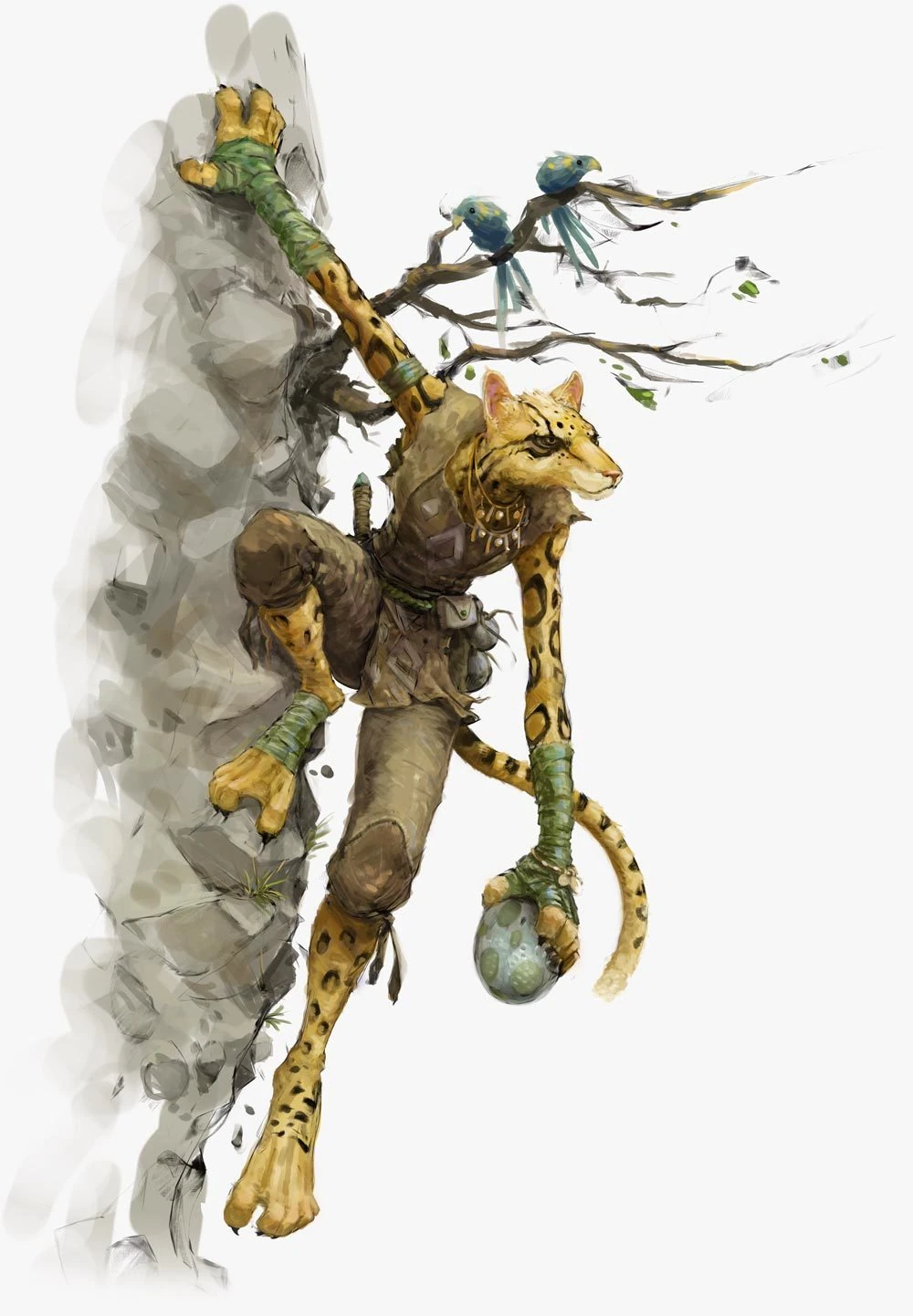
Tabaxi are feline humanoids who move with a sleek, unhurried grace that belies how quickly they can act when something demands it. Their bodies are covered in short, dense fur ranging from the solid black of a panther to the spotted gold of a leopard to the bold stripes of a tiger — no two Tabaxi wear the same coat, and within the Beast Tribes it is common to identify an individual's lineage at a glance by their markings alone. Their eyes are large and expressive, drawing from a broad palette of yellows, greens, blues, and vivid oranges, and they hold in them a quality that most other peoples describe the same way: curiosity. Not idle curiosity — the kind with teeth.
Tabaxi stand roughly human height, though they tend toward the taller end, with slender frames that conceal a wiry, coiled strength. Their tails — long and active — provide constant balance and betray emotion in ways their composed faces often do not. Their hands are dexterous, their claws retractable, and their preferred mode of movement shifts fluidly between upright and all-fours depending on what the terrain demands. Watching a Tabaxi navigate rough ground is watching something built exactly for the purpose.
More than any other member of the Beast Tribes, Tabaxi are defined by an outward pull — a wanderlust that sits at the intersection of instinct and identity. They collect things: stories before objects, experiences before either. A Tabaxi who has never left the forest where they were born is quietly pitied by their kin. A Tabaxi who has crossed three nations and come home with tales nobody has heard yet is celebrated. This drive makes them natural scouts and traders for the confederation — roles they have occupied for as long as any elder can remember.
Within the confederation's political landscape, Tabaxi occupy a position of soft power built almost entirely on information. They know more about the outside world than anyone else, and they know it more recently. Other tribe leaders consult them before making decisions that involve foreign parties. The Tabaxi do not hold formal authority at confederation councils, but they have learned — over many generations — that being the most informed person in the room is authority of a different and often more durable kind.
Culture
The following reflects Tabaxi culture as practiced within the Beast Tribes confederation. Tabaxi who have left the confederation, or who were raised in other nations, may develop markedly different customs — though the wanderlust rarely goes anywhere.
The Storytelling Tradition
The most revered members of a Tabaxi tribe are rarely its strongest fighters or its wisest tacticians. They are its eldest — specifically, those who have lived long enough to carry the widest array of stories. Tabaxi elders are treated as living libraries, consulted not just for advice but for precedent, and it is considered a serious social failing to let a story die with the person who held it. When an elder grows old, younger Tabaxi sit with them deliberately, listening, asking questions, committing the tales to memory so they survive the telling.
This gives Tabaxi communities a particular relationship with history. They do not write it down — or rather, they do not trust the written version as much as the spoken one, which can be corrected, refined, and argued over. A Tabaxi settlement without a strong oral tradition is a settlement losing itself, and everyone in it knows it.
The competition for who carries the best stories is ongoing and friendly. Among younger Tabaxi, the desire to acquire a tale worth telling is itself a motivating force — an adventure undertaken partly for the adventure and partly for the account of it that can be brought home afterward. This creates a cultural feedback loop: the better the story, the more it inspires the next journey.
What the Cat Collects
Tabaxi accumulate things, but rarely the things other peoples value. Objects gather dust; experiences do not. What a Tabaxi treasures is the particular quality of a moment that cannot be reproduced — the exact phrasing of a negotiation in a dialect they'd never heard before, the way a specific market smelled at dawn, the words a stranger used when they thought no one was listening. These go into the collection, catalogued in a memory that tends toward the eidetic.
Information is treated the same way. A widely traveled Tabaxi is often a remarkable source of practical intelligence — not because they set out to gather it, but because they notice everything and forget nothing, and have an instinct for what detail might matter later. Other peoples sometimes find this unsettling. The Tabaxi find the concern baffling. They are simply paying attention.
Some Tabaxi extend the collecting instinct to objects, but even then the object's story outweighs its intrinsic value. A chipped cup from a historically significant tavern outranks a pristine silver goblet. The object is the memory made physical, and without the story it is just weight to carry.
Wanderlust & Homecoming
The tension at the center of Tabaxi community life is the one between leaving and returning. The impulse to go — to seek out something new, to add another thread to the tapestry — is deeply felt and broadly respected. Young Tabaxi who announce they are leaving to explore are rarely talked out of it. The community sends them off with stories to carry and a standing invitation to bring new ones back.
But the homecoming matters just as much. A Tabaxi who leaves and never returns is not celebrated — they are mourned, quietly, as someone who stopped feeding the community they came from. The expectation is not that you stay, but that you come back richer than you left in experience if nothing else.
The ritual of homecoming in most Tabaxi tribes involves a formal telling — the returning traveler recounts their journey to the assembled community, who listen not as an audience but as archivists. What is worth keeping gets added to the tribe's collective memory. The traveler is welcomed back as someone who has expanded what the tribe knows about the world. This is the moment young Tabaxi grow up imagining.
Outsiders & First Contact
Within the Beast Tribes, Tabaxi tribes serve most naturally as the confederation's link to the outside world. Their wandering nature makes them skilled traders, their sharpness makes them effective scouts, and their ease with strangers — combined with a genuine interest in other peoples — makes them the face most other nations associate with the Beast Tribes as a whole. When diplomatic contact is needed, it is often a Tabaxi who makes it first.
This role suits them temperamentally. Tabaxi find other peoples interesting, which reads as warmth even when it is really curiosity. A Tabaxi diplomat is not performing enthusiasm for the culture they are navigating — they genuinely want to understand it, and this comes through in a way that most peoples respond to positively.
The limitation is that broad interest can be mistaken for shallowness. A Tabaxi's curiosity is genuine but wide rather than deep; they collect impressions of many cultures rather than becoming an authority on any one. Peoples who expect a dedicated advocate sometimes find that the Tabaxi who was so enthusiastic about their trade agreement last year has since moved on to a new fascination. The Tabaxi do not consider this a failing. They consider it accurate.
Names & Identity
Tabaxi names operate on two levels: the given name used within family and tribe, and the descriptive title-name that accumulates through lived experience. The title-name is not fixed at birth — it accretes. A young Tabaxi might be known simply as "Spotted Leaf" for years before travel adds qualifiers, until they become "Spotted Leaf Who Crossed the Iron Desert" or "Spotted Leaf Three-Times-Returned." Long title-names are worn without irony; they are a record of a life fully engaged with the world.
Outsiders receive a shortened version for practical use, but within a Tabaxi community the full name is used in formal contexts. Introducing yourself by your complete title-name at a homecoming ceremony is how you demonstrate that the journey was worth making — that you came back with something more than you left with, and that the community is richer for your having gone.
Statblock
layout: Basic 5e Layout
name: Tabaxi
source: Yggdrasil World System
size: Medium
type: humanoid
subtype: ""
alignment: any alignment
ac: 10
hp: —
speed: 30 ft., climb 20 ft.
stats: [10, 10, 10, 10, 10, 10]
senses: darkvision 60 ft.
languages: Common, plus one of your choice
cr: "—"
traits:
  - name: "Cat's Claws"
    desc: "Your claws are natural weapons, which you can use as Unarmed Strikes. When you hit with them, the strike deals Slashing damage equal to 1d4 plus your Strength modifier, instead of the Bludgeoning damage normal for an Unarmed Strike."
  - name: "Feline Agility"
    desc: "Your reflexes and agility allow you to move with a burst of speed. When you move on your turn in combat, you can double your Speed until the end of the turn. Once you use this trait, you can't do so again until you move 0 feet on one of your turns."
Designer Note
Tabaxi are built around mobility and curiosity — the climb speed and agility burst make them exceptional at repositioning, fitting their scout and explorer role within the Beast Tribes. Currently two traits; a third (such as proficiency in Perception or a once-per-rest social feature reflecting their information-gathering instinct) could be added to bring them fully in line with the three-trait 2024 standard if desired.
See Also
- Beast Tribes — their primary nation and homeland
- _Species Index
- Yggdrasil World System